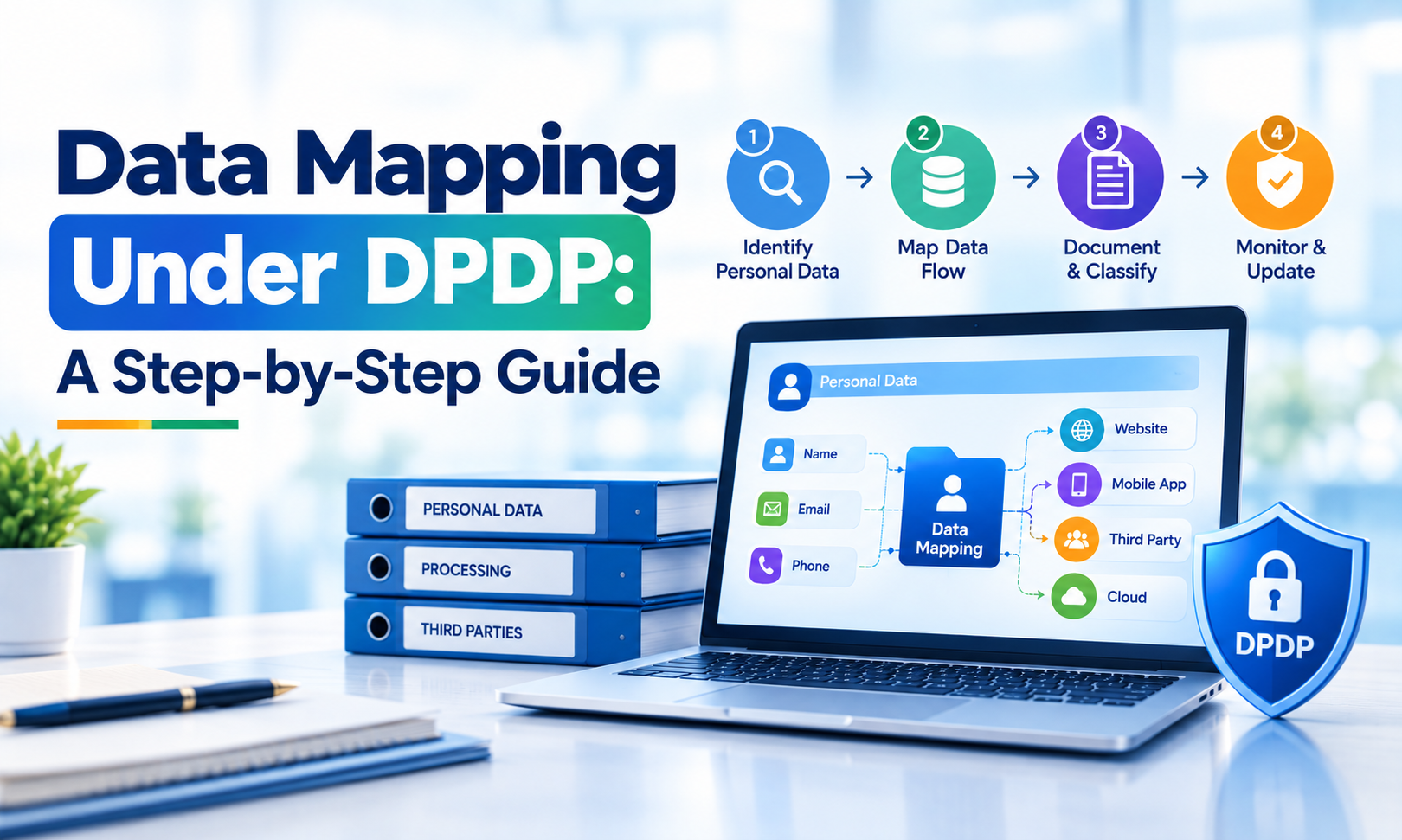
A step-by-step guide to mapping personal data flows under DPDP — from entry points and internal system hops to external transfers and retention triggers — distinct from a static data inventory.
A data inventory tells you what personal data exists and where it sits. Data mapping answers a different, harder question: how does it move? A customer's phone number doesn't stay put once it's collected at registration — it flows into a CRM, gets pulled into a billing system, maybe reaches a delivery partner, sometimes lands in a marketing platform, and occasionally crosses into a cloud server outside India along the way. Under the DPDP Act, understanding that movement matters as much as knowing the data exists in the first place, because consent, purpose limitation, and breach containment all depend on tracing exactly where information goes once it leaves its point of entry.
This is a step-by-step guide to running that mapping exercise properly — as a project with a defined sequence, not a spreadsheet filled in during a slow afternoon.
Step 1: Define the Boundaries Before You Start
Trying to map every data flow across an entire organization at once tends to produce a project that never finishes. A more workable approach scopes the first pass around a specific business function or data category — customer onboarding, employee records, or payment processing, for instance — and expands outward once the methodology is proven. Decide upfront whether this first pass covers customer data, employee data, or both, and which departments are in scope for round one.
Step 2: Identify Every Entry Point
Map where personal data first enters the organization. This is usually broader than people expect: web forms, mobile app sign-ups, in-person registration, call-center intake, purchased or referred contact lists, employee onboarding paperwork, and vendor-supplied data (like a partner sharing lead information) are all distinct entry points, each with its own collection context and — critically — its own notice and consent requirement.
For each entry point, capture: what's collected, through which channel, and what the stated purpose was at the moment of collection.
Step 3: Trace Internal Movement
Once data enters, follow it through the organization. A customer's registration details might move from a web form into a CRM, then get synced to a support ticketing tool, then pulled into an analytics dashboard, then referenced by a finance team reconciling invoices. Each internal hop is worth recording, because purpose drift often happens quietly at this stage — data collected for one reason gets used by a different team for a different reason, without anyone deciding that deliberately.
A simple flow table works well here:
| Data Element | Source System | Destination System | Purpose of Transfer | Method |
|---|---|---|---|---|
| Customer phone number | Web registration form | CRM | Account management | API sync |
| Customer phone number | CRM | Marketing platform | Promotional messaging | Manual export |
| Employee salary details | HRIS | Payroll processor | Salary disbursement | Automated feed |
That second row is a common flag: if the marketing use wasn't part of the original notice shown at registration, this transfer needs its own consent basis — the mapping exercise is precisely what surfaces this kind of gap before a regulator does.
Step 4: Map External Transfers Separately
Data leaving the organization's own systems deserves its own layer of scrutiny, because it introduces a Data Fiduciary/Processor relationship (or a disclosure to another Fiduciary) that internal movement doesn't. For every external transfer, record who the recipient is, whether they're acting as a processor or an independent fiduciary, what data specifically is shared, and whether the transfer crosses outside India. That last detail matters for two reasons: it flags where Section 16's cross-border transfer provisions apply, and it flags where a sector-specific rule — like RBI's data-localization requirements for certain payment data — might impose stricter conditions than DPDP alone.
Step 5: Note Where Data Stops — or Should
Mapping isn't just about tracking where data goes; it's also about identifying where it should terminate. For each flow, note the retention period and what triggers deletion — the end of a customer relationship, the expiry of a statutory retention requirement, or a consent withdrawal. This is where most organizations discover flows with no defined endpoint at all: data that arrived years ago and simply never left, because nobody built a deletion trigger into the process that brought it in.
Step 6: Run the Exercise as Interviews, Not a Survey Form
The most reliable data mapping doesn't come from emailing a spreadsheet template to department heads and waiting for responses — it comes from short, structured interviews with the people actually doing the work. A marketing analyst can describe, in five minutes of conversation, exactly which systems get pulled into a campaign and where the contact list originally came from — details that rarely surface accurately through a form filled out under time pressure. Pairing IT's system-level view (what integrations technically exist) with these operational interviews (what people actually do day to day) consistently catches flows that either method misses alone.
Step 7: Visualize Before You Formalize
Once the raw data is gathered, a visual flow diagram — even a simple one, department by department — makes gaps far more obvious than a long table does. Seeing a line from "web form" to "marketing platform" with no consent checkpoint in between tends to prompt the right question immediately, in a way that scanning row 47 of a spreadsheet rarely does.
Step 8: Turn the Map Into a Living Record
A data map has a shelf life measured in months, not years, unless it's actively maintained. Build in a trigger to update it whenever a new system, vendor, or integration is introduced, and set a recurring review — twice a year is a reasonable starting cadence for most organizations — to catch flows that changed quietly in between, like a new marketing tool added without anyone updating the original map.
What a Completed Map Actually Enables
Once this exercise is done properly, several other DPDP obligations become dramatically easier: writing an accurate, itemized notice under Section 5 (because you know exactly what's collected and why), scoping a processor contract precisely (because you know exactly what data a given vendor receives), and responding to a breach within the required window (because you already know which systems and third parties were touched, rather than discovering it mid-crisis).
The honest starting point for most organizations is realizing that nobody currently has this picture in full — not IT, not compliance, not any single department head. Building it is genuinely cross-functional work, and it tends to reveal at least a few data flows that surprise everyone involved, including the people who set them up in the first place.